


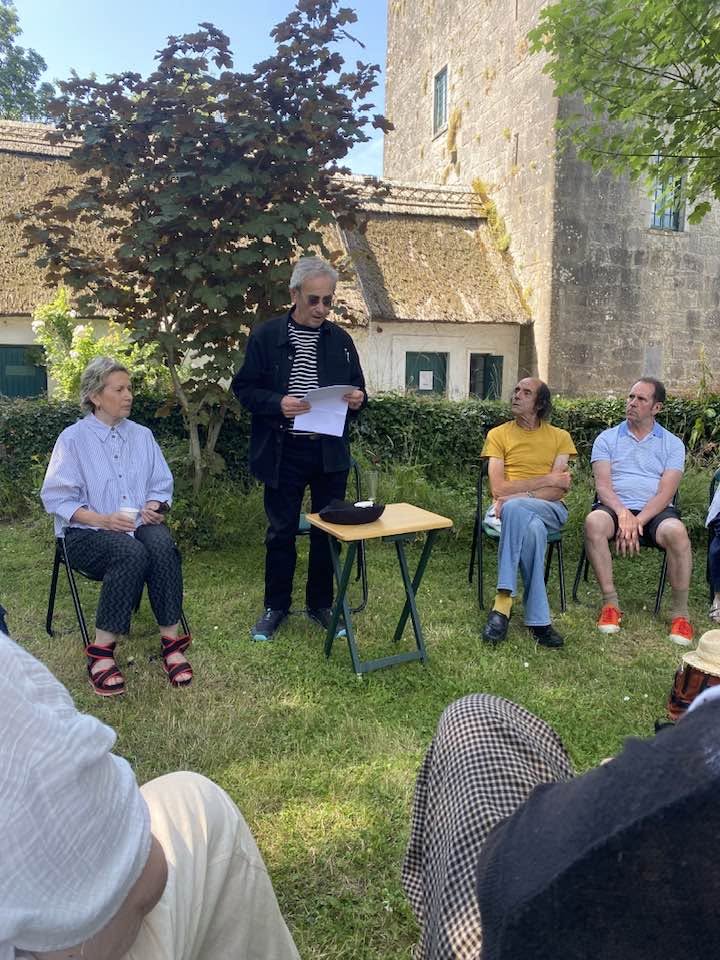
An Introduction to the exhibition, Sioban Piercy: Restless Objects, by Professor Timothy Emlyn Jones. Presented at the opening, Saturday 11 July 2026, at Thoor Ballylee.
It was a real delight when Sioban Piercy invited me to open this exhibition. I have known her for many years, especially through her work with Leonie King on the annual Impressions exhibitions, and through the Royal Society of Printmakers where we are both Fellows. I have always been fascinated and intrigued by Sioban’s work, not just in her asemic writing but also the aesthetic qualities and highly personal way in which she articulates it. Few artists make such fine poetry from seemingly unintelligible marks on translucent paper.
Her work is visually striking, inviting you in and rewarding you with a sense of mystery. What is all that bizarre writing trying to say? Is it unintelligible, or am I failing to read it properly?
I am as intrigued by the way in which it fascinates as much by its undeniable aesthetic appeal. You’re not supposed to understand it. But you are supposed to maintain your hope that there is something to understand. The more time you spend engaging with her book sculptures, the deeper you become enmeshed in them. Once you have become entranced by them, there is no way out. It’s a bit like a lobster pot in which there is an illusion of an out-door that keeps you living in hope.
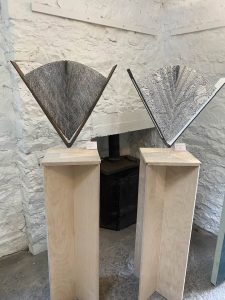
Some of her book works, and ‘An Ocean Written’ (close to the entrance to the exhibition) and ‘Small Impatient Object (to be seen in the blue room in the tower) in particular, remind me of the origami paper fortune tellers or ‘cootie catchers’ of childhood. I recall other children playing with them and the mystery of what they foretold was captivating, and I suspect that fascination might be true for Sioban too.
It was in putting my thoughts together for this afternoon that I realised how the intrigue works for me, not in general ,but for me in particular. It comes about through a sense of fellow feeling. I suspect many of you might share it.
There is both a gentle interplay and a dynamic tension between language and visuality. Language has equal potential to be a mode of freedom and of control, while visuality offers modes of rescue. Both are modes of visualisation – how often does the tongue say “picture this”. On the other hand, the eye seems to say “not like that but like this,” but promptly gives you illusions to take the place of the visible world. Mystery lives somewhere in the region between the tongue and the eye. A great deal of my own work takes place in that liminal space, and I can see how Sioban Piercy is playing in the same sandpit.
In this exhibition, Sioban’s work has a context it lacked when I saw it in previous exhibitions, such as in Oranmore Castle, and the Bankside Gallery next door to Tate Modern in London. Here, we are stalked by the ghost of WB Yeats. If you turn round quickly enough, you may see him standing at the back of the room, nodding sagely. Didn’t see him? You weren’t quick enough. But Sioban Piercy was quick enough.
For many, it is the spiral staircase in Thoor Ballylee which inspired Yeats’s concept of the gyre that is so important. It makes you dizzy as you rise from darkness to approach the light. But for Sioban, equally or more inspiring is his and his wife George’s discovery of automatic writing to communicate with the spirit world. I was fascinated to learn that Sioban followed the Yeats’s lead, not just in her works of art, but also in communicating with the spirits in the ether(net). She has done it in her own way, in the form of a mode of spiritual communication that is new to our age, and which Yeats would have envied. She asked artificial intelligence (AI) to comment on connections between her work and Yeats’s automatic writing. Let me read you three short extracts of what these spirit voices of the ether(net) came up with:
Both W. B. Yeats’s automatic writing and Sioban Piercy’s asemic writing explore what happens when written marks move beyond ordinary communication….
Yeats’s automatic writing seeks messages, systems, and spiritual revelation, whereas Piercy’s asemic writing emphasises ambiguity, materiality, and the unstable process through which meaning is made…..
Ultimately, Yeats’s automatic writing and Piercy’s asemic writing reveal two different ways of understanding the power of written marks. Yeats moves from mystery toward system, using automatic writing as a path to spiritual knowledge and symbolic order. Piercy moves from the appearance of system toward mystery, allowing writing-like forms to remain suspended between sense and non-sense. Both practices show that writing is not only a tool for communication, but also a visual, material, and imaginative field where meaning can be made, questioned, and withheld.
Up to now, I have been sceptical of AI, seeing it as industrial scale plagiarism, and not something to be welcomed, even though it has the appeal of the unknown. Sioban saw a potential that I missed. While she asked AI to compare her work to that of Yeats, what she has also done is to liken the spiritual voices of Yeats’s automatic writing to the writing of AI, seeing the latter as a form of spiritual intelligence. She recognised a potential I hadn’t seen for myself.
The other day, I followed Sioban’s example by asking the ghosts of AI to comment on the potential of language to be meaningless yet seemingly profound, that being the area in which Sioban operates. It told me:
“The word is merely a map of the silence it broke, yet the sentence always returns to the grammar of the unsaid.”
Then it added:
“Before the echo can exist, it must first teach the throat how to forget the sound it is about to make.”
And:
“The tongue does not speak the word; rather, the word uses the tongue to remind the ink of the thoughts it chose to drown in.”
The question arising from this is less, ‘What is the original source of these utterances’, because there may be none, than, ‘Could I have made up something equally good myself?’
The quality of AI may depend more on the creativity of the person using it than on the spirit-being that this new form of intelligence seems to evoke. If it doesn’t work for you, you’re not doing it right.
What AI came up with is reminiscent of a similar voice heard by 1950s art-cinema goers in the film classic ‘Orphée’ by Jean Cocteau. The film centres on communication with the dead, and early in the film, Orpheus finds inspiring poetry by tuning in to a dead poet being broadcast on the radio in the car of the angel of death. The poems sounded strongly like the voice that the spirit-of-the-ether came up with for me from a realm that I want to call the meaningless profound. That is exactly the realm in which Yeats excelled and in which Sioban Piercy has become pre-eminent.
Other historical precedents for Sioban’s ascemic writing can be found in Kurt Schwitters audio art as well as in 1960s and 70s concrete poetry and in sound poetry. John Furnival, Henri Chopin and Dom Sylvester Houedard all produced writing that does not make discursive sense, but does make perfect aesthetic sense. Bob Cobbing gave fascinating performances of sound poetry in which the script was an abstract drawing reminiscent of Sioban Piercy’s books which he ‘read’ out loud. They sounded crazy but they were fascinating. Whether these precedents were actually influences for Sioban is not for me to say.
What I do feel more confident about asserting is that Sioban Piercy’s art is itself likely to turn out to be influential. Her work is deeply rooted in the Irish tradition of the spirit world yet is also international in outlook and status – as is the case of her spirit mentor who is still standing at the back of the room trying to contribute to this conversation, if only you can see him.
Timothy Emlyn Jones is a Welsh-Irish artist and writer who exhibits internationally and is represented in public collections in a number of countries. His poetry collection ‘The Language Game’ has just been published by Salmon Poetry Ireland, and he has published numerous essays. He has held professorships at Wimbledon College of Art, Glasgow School of Art, and most recently at Burren College of Art with the University of Galway. He lives in Kinvara, Co Galway.


